

November 15, 2026

Seismic behavior, ductility and lightness: Why can lightweight construction save your life?

It's not fragility, it's engineering: learn why a lightweight, monolithic system better withstands the Earth's movement

Hello everyone, it's great to have you back! In the last blog post, we briefly discussed the advantages of thermal insulation, which refers to the use of... expanded polystyrene (EPS) in Covintec And today we're going to delve deeper into the topic of EPS. Now we'll talk more specifically about a great benefit resulting from it. use of EPS in construction

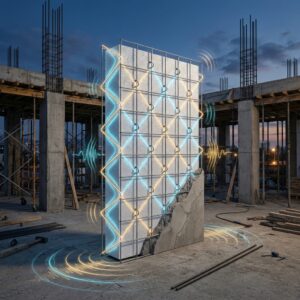
As we described earlier, a wall or Covintec panel It consists of a steel grid, covered by a structural layer of mortar one inch thick on both sides and a core of EPS as an insulator. This core is the main difference between a reinforced concrete wall and a Covintec wall, both in the thermal and acoustic, as in the structural aspect, because, although their structural capabilities may seem similar, the EPS usage It generates a rather interesting kind of goodness, the lightness.

But why the lightness Is it a benefit? Well, let's clarify first that it's a relative lightness compared to the weight of traditional masonry and reinforced concrete construction. The fact that Covintec is called a lightweight construction It doesn't mean it can fly away like Dorothy's house in The Wizard of Oz.

The lightness has a great importance as to seismic engineering It refers to:

  1. More efficient foundations: By requiring less gravitational load on the soil, or weight, the structural elements of the foundation are more slender and economical.
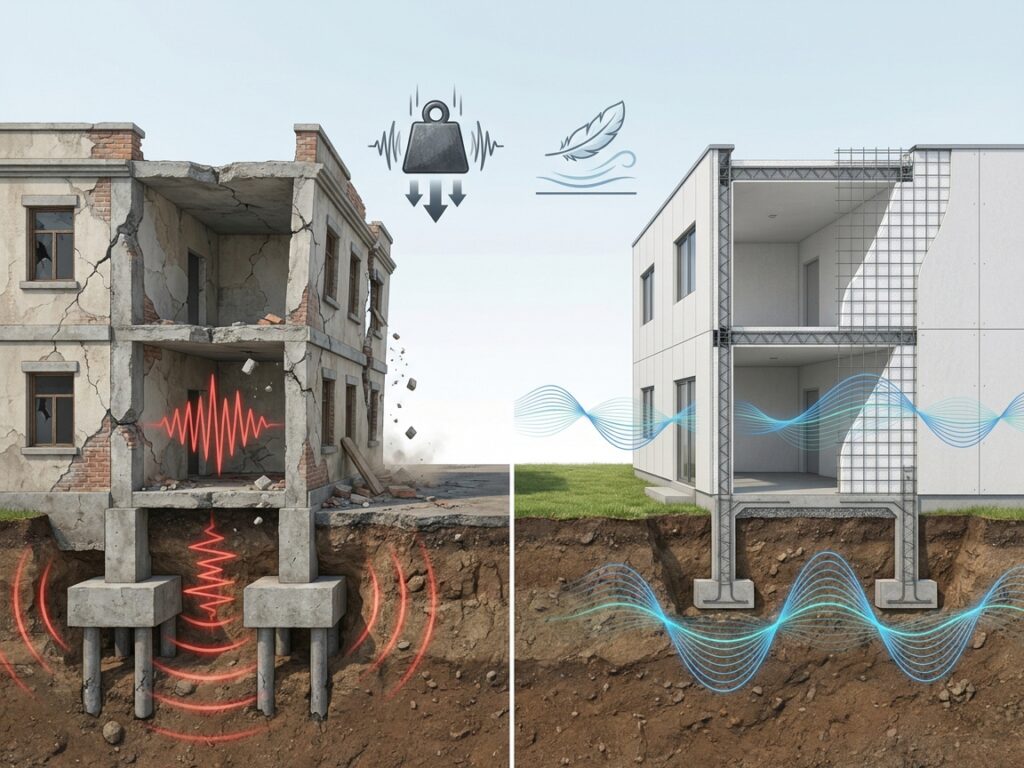
  2. Less destructive impact: Although it may sound counterintuitive, earthquakes act more violently on heavier structures.

Let's reminisce a bit about our high school physics classes. I'm sure many of you will remember this formula:

F = m * a

This formula describes the relationship between mass, acceleration, and force. Applied to a building, mass is the total weight of the structure, acceleration is the force with which an earthquake impacts it, and therefore force is the product of these two concepts. So, if your building is lighter, up to 60% lighter as is the case with Covintec, you'll be reducing the inertial force (the force that tries to bring the structure down) to less than half!

Covintec
SEISMIC SHAKE
POLYSTYRENE PANEL + STEEL MESH Covintec construction system · the structure flexes and resists

In addition, there is a important aspect, Covintec It is a system monolithic and with structural redundancy, so it can distribute a lot better the seismic forces in the entire structure thanks to his high-strength steel and his armor made of non-deformable triangles, Traditional masonry constructions, consisting of hundreds of elements bonded with mortar, are often unable to withstand the stresses caused by seismic forces and fail dramatically. When a wall separates, it loses axial load-bearing capacity, which can often trigger a chain reaction (due to the lack of structural redundancy), especially when the entire structure depends on these walls.

These failures are much more common when the masonry is not confined with reinforced concrete elements, which is why the NTC and most current regulations prohibit construction without the necessary confinement.

In fact, there is one proof very basic made by the MythBusters in which we can see the actions of a seismic force On a masonry construction and a light wooden construction, it is precisely seen how the earthquake acts much more violently on the masonry and begins to separate the blocks when the joint fails, presenting the typical pattern of stepped horizontal cracks.
Is important It's worth mentioning that this example of masonry is not confined, which makes its failure even more dramatic. However, it's a very good example that demonstrates how a lighter construction is less susceptible to the seismic stresses.

Now you know why your Covintec construction is much safer in earthquakes, as well as being incredibly comfortable. It's all thanks to this element that we often overlook: EPS.